

Why "High-Functioning" and "Low-Functioning" Labels Don't Work
The neurodivergent experience is bigger than that.

I realized I was autistic, and had ADHD, over the course of this past year. I say realized instead of found out or discovered because, really, this wasn’t much of a surprise to me. Once I had the language and framework to describe my experience, and connected all the dots, it made a lot of sense.
It didn’t surprise my immediate family, either. After all, they saw me grow. They watched three-year-old me twirl toothbrushes in front of her eyes as she wandered around and daydreamed, or eleven-year-old me press her fists into her cheeks when she was excited, or fifteen-year-old me twirl a (very specific) pen in front of her eyes as she read a book (which had to be in a very specific font, otherwise it hurt my brain). These behaviors are called stims, but neither I or my parents knew that at the time. It’s just what I did.
They coached me through middle school meltdowns over the feel of denim jeans against my legs or not being able to get the tangles out of my American Girl doll’s hair. They created a chore chart with reminders and a reward system because I’d always forget to clear the table or do the dishes. They chose school curriculums (I was homeschooled) with bright colors, games, and engaging interfaces because I couldn’t focus otherwise. They’d sit and listen as I would talk for hours about my latest obsessions.
But because I was social and talkative, because I loved being around people and had a lot of friends, they never considered that I was autistic. Because I did well in school, and I could sit still, they never considered ADHD.
And that’s not their fault. It’s more common knowledge now that neurodivergence looks different in women and girls than people would expect. Or, to rephrase: the images that come to mind when we think of autism and ADHD are based on how it presents in boys. But that wasn’t common knowledge in the 2000s and 2010s, when I was growing up. My parents didn’t know. My other educators didn’t know. My friends didn’t know. So I flew under the radar, even to myself.
I knew I was different, that a lot of my behaviors weren’t typical. I just didn’t know why. Or, I thought certain things were normal that weren’t. I thought everybody watched social situations like a hawk, reading the room, adjusting their body language, expressions, and reactions based on everyone else’s. I thought it was just an “introvert thing” that social situations left me so drained I couldn’t do anything.
But now I do. Now I understand what masking is—putting effort and energy into trying to behave like everyone else behaves—and how I thought that was normal. If you think to yourself, “It is normal!” then let me ask you: did a situation appear in your mind when you thought that? A situation where you felt like you masked yourself? Hold that feeling up to the light. I’ve got a couple questions.
Does that feeling appear every time you’re around people, whether it’s one-on-one or at a party? Every single time? Do you rehearse what you’re going to say before you speak to a barista, open a Christmas gift, or greet a distant friend? Do you feel like you’re performing? Does that sense of performance follow you home, and you catch yourself self-editing even when you’re alone, performing for the invisible crowd? This is masking. It’s exhausting. And it’s a major element of neurodivergent experience, particularly for women, who are usually exceptional at it. Or at least, they feel compelled to put effort in trying.
This is why the “high-functioning” label irks me so much. When someone says, “Oh, but they’re high-functioning,” in reference to someone’s diagnosis, what they really mean is that they are good at masking.
And they mean it as a compliment. “High-functioning” softens the blow. It makes autism and ADHD and other neurodiversity palatable, relatable, even. A quirk. A meme. An eccentric personality trait. It means the “high-functioning” neurodivergent person is a good performer. This is in contrast to “low-functioning” neurodivergent people, who are not good performers.
The problem with these labels is that it’s rooted in the perspective of the outsider—someone who has no idea what’s going on behind the eyes of the supposedly “high-functioning” neurodivergent person.
I’ve actually had people tell me I’m “high-functioning,” and others who didn’t say it in words, but said it in a raised eyebrow or a “wow, really?” when I mentioned my neurodivergence to them. And this reaction does make sense, from an outsider’s point of view. I’m good at school. Reliable at my jobs. I look you in the eye when I talk to you. I’m friendly, personable, knowing when to ask you questions about yourself and when to talk about myself and yada yada. I probably know more about social cues than you do. Why? Because I’ve had to think about it. I’ve spent my whole life studying other humans like they’re a textbook and copying their behavior. I walk into a room and read it so I know what to do, and hopefully look natural doing it.
So, sure. “High-functioning,” based on what you can see. But what about all that you can’t see?
Say I’m out to lunch with you. I’ve been carefully timing my eye contact and making sure my body’s turned in a way so I seem open and inviting. I’ve zoned out of what you were saying about five times, but I know enough to follow along, so I nod and say “uh huh” and hope you didn’t notice my glassy eyes. I’m reading your lips to understand you because, besides your voice, I’m also hearing the conversations of the tables next to us, the clinking of spatulas on frying pans coming from the kitchen, the clatter of the bathroom doors opening and closing, and the clatter of forks on plates. Everything’s too loud, and I’m starting to feel it. After you leave and resume your day, I sit in the silence of my car for a while to try and pull it together so I can go home and do my laundry. I manage to do my laundry (it takes an hour and a half to fold, because I keep losing motivation), and now I don’t have enough energy left to make myself an actual dinner (so pretzels and peanut butter it is), or shower.
And here’s the thing—I enjoyed talking to you. You’re lovely. You bring me joy. But the fact remains that performing (and performing while overstimulated by noise or whatever else) is draining. And now I don’t have enough energy for the laundry. Or to do all the steps necessary to eat or shower.
If I have enough days like that in a row—ending the day too drained by social or sensory stimuli to care for basic needs and responsibilities—I shut down. Literally. I become immobile. Moving is a struggle. Even speaking can be a struggle: there have been a few times that speech became so difficult I felt that I’d lost the ability. In these moments, I cancel plans and tell people I’m sick, because in a way, I am. I used to think these were just “depressive episodes,” but now I know better. I’m experiencing an autistic shutdown.
But all this is invisible to you. You may look at me and see “high-functioning,” but there is a whole iceberg beneath it. I encompass it all. Masking, and its results.
There’s a better way of thinking about this than “high-functioning” or “low-functioning.” Let’s hone in on autism specifically. It’s called the autism spectrum for a reason, but it’s not a spectrum with one end as “high-functioning” (as close to neurotypical as you can get) and the other as “low-functioning” (as far away from neurotypical as you can get). At least, it shouldn’t be.
Researchers and medical professionals are beginning to classify autism in levels, with level one autism being mild and level two being more severe, and so on. Distinguishing the presence and intensity of traits is fine, and helpful, I think—but “mild and severe” is just a rephrasing of “high-functioning and low-functioning.” Terms like that undermine, in my opinion, the needs of autistic people who would be classified as level one.
I prefer to think of the autism spectrum as a color wheel.
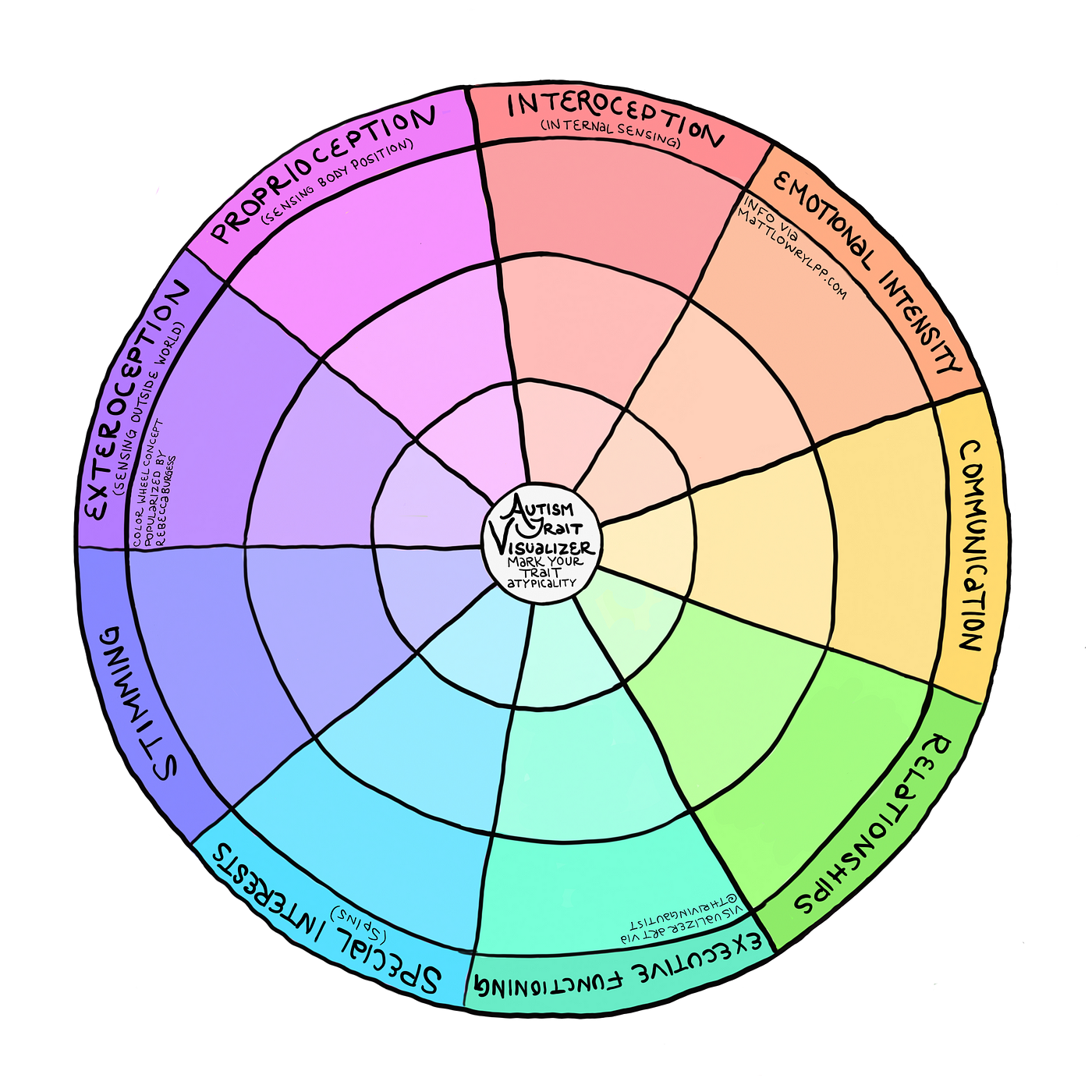
Every color on this wheel is an autistic trait (like stimming), or something they struggle with (like communication). One autistic person is very orange, meaning they experience emotions very deeply, but not very red, meaning they can interpret their body’s internal cues (hunger, pain, bathroom needs) well. Another autistic person is the opposite: they experience duller emotions, and struggle to interpret internal cues. Both people are autistic. Their color wheels might look different from each other’s, but that doesn’t make them more or less autistic, because there’s no such thing. “On the spectrum” means, or should mean, 100% autistic. Not a little, not a lot. Just autistic.
Calling someone “high-functioning,” and meaning it as a compliment, encourages them to hide their “low-functioning” moments from you, and maybe even from themselves. It encourages them to keep up a high level of performance that is not sustainable. It also encourages them to beat themselves up when they can’t perform at the level expected of them. If the neurodivergent person internalizes this need to be “high-functioning”—and, as it follows, bullies themselves when they don’t meet the neurotypical standard ingrained in them—it leads to mental collapse. Until they embrace themselves as a whole (accepting both their “high-functioning” and “low-functioning” moments), they’ll always feel like outsiders. To you. To themselves.
So next time someone tells you they’re neurodivergent, don’t congratulate them on being “high-functioning.” Give grace, support when and where they need it, and encourage their strengths. Set the example for their self-acceptance by embracing their “high-functioning” and “low-functioning” moments yourself. Celebrate them, holistically, and give them the freedom to flourish.